
After years of leading massive Data Science and Machine Learning teams in big tech, I thought I understood how to read a market. But leaping head-first into the uncertainty of startup life fundamentally shifts your perspective. In the corporate world, you manage scale; in the startup world, you are managing survival.
Over the past year at AgentWeb, we’ve worked closely with more than 20 startups—from solo-preneurs bootstrapping their way to relevance to VC-backed teams sprinting toward a Series A. We’ve seen companies scale beautifully, and we’ve watched others burn their entire runway on campaigns that generated zero revenue. This isn't a highlight reel; it’s an unfiltered look at the structural patterns that separate the survivors from the statistics.
The Portfolio: 10 Verticals, One Recurring Pattern
Our observations aren’t limited to a single niche. We’ve worked across HealthTech, MarTech, HRTech, PropTech, FinTech, EdTech, and DeepTech. We’ve seen everything from clinical decision algorithms to automated robotics and hyper-local service businesses.
What surprised me most wasn't the difference in product architecture between these companies—it was the striking, undeniable similarity in their market entry failures. Regardless of the vertical or the pedigree of the founders, nearly every company stumbled at the exact same three inflection points. B2B buyer psychology remains relatively constant, whether you’re selling software to a hospital administrator or an HR director.
Stage 1: The 'Premature Precision' Trap (0-10 Customers)
At the absolute genesis of a company, your goal isn't scaling; it’s discovery. The most dangerous element of this stage is the illusion of certainty.
We frequently see founders fall into what I call the Premature Precision Trap. Driven by the pressure to present a cohesive narrative to investors, they lock in an Ideal Customer Profile (ICP) before they have the data to justify it. They craft hyper-targeted messaging and launch narrow, expensive campaigns, only to realize their actual paying customers look nothing like their initial assumption.
In my experience, the startups that navigate this '0 to 10' desert the fastest are those that cast a systematically wider net. They run structured experiments across 3–4 adjacent segments simultaneously. By measuring real signals—like time-to-value and feature utilization—they let the data collapse the hypothetical ICP into a reality-based persona.
At AgentWeb, we deliberately inverted the traditional customer success model during our first few months. We optimized our efforts toward the end of the initial contract period. Why? Because that’s the crucible of truth. It’s the moment a customer either renews (a value signal) or churns (a misalignment signal).

In the early stages, casting a wider net allows real usage data to define your ICP, rather than relying on hypothetical assumptions.
Stage 2: The Paid Ads Trap (10-20 Customers)
Scaling from 10 to 20 customers is the most delicate transition in the startup lifecycle. This is where we see the most preventable, catastrophic failures.
The pattern is consistent: a startup sees early validation, gets a few happy customers, and immediately pours high-octane fuel on the fire by activating paid ads. Initially, the dopamine hit is real. Click-through rates are high, and the cost-per-lead looks healthy.
And then, disaster strikes. The leads go cold. Conversion to pipeline hits zero.
Here’s the brutal truth: the problem isn't the ads. The problem is the total lack of sales infrastructure. At this stage, most founders are still selling reactively. When a campaign dumps 50 leads into an inbox in a single week, the system breaks. There’s no automated routing, no multi-touch nurture sequence, and zero CRM discipline. As we saw in our Maxi case study, paid acquisition strictly amplifies your existing motion. If that motion is broken, ads just help you discover your flaws at a much higher financial cost.
The Channel Trust Hierarchy
One of our most counterintuitive insights involves the behavioral economics of trust. Many founders view LinkedIn and cold email as interchangeable pipes. They aren't.
For an unvalidated brand, the trust deficit in email is enormous. A cold email exists in a vacuum. But LinkedIn is architecturally different. A founder’s profile is a living proof-of-work document. When you reach out via LinkedIn after a prospect has seen your content, the trust baseline is elevated. We’ve found that founder-led LinkedIn outreach generates 3-5x higher response rates than cold email for new brands.
Is your LinkedIn profile working as hard as your product? Get a free AI-powered audit of your founder profile, company page, and content strategy — and find out exactly what's costing you trust with prospects.
Get Your Free Audit →The Product Hunt Illusion
We need to have an honest talk about Product Hunt. Many of our B2B cohorts insisted on launching there. They hit #1, popped the champagne, and then watched their 30-day retention numbers flatline.
Product Hunt is great for DevTools or consumer tech, but its audience is mostly other founders and enthusiasts. If you are selling to a hospital procurement manager or a logistics lead, they aren't on Product Hunt. Chasing vanity metrics there is a fatal distraction from your true target audience.
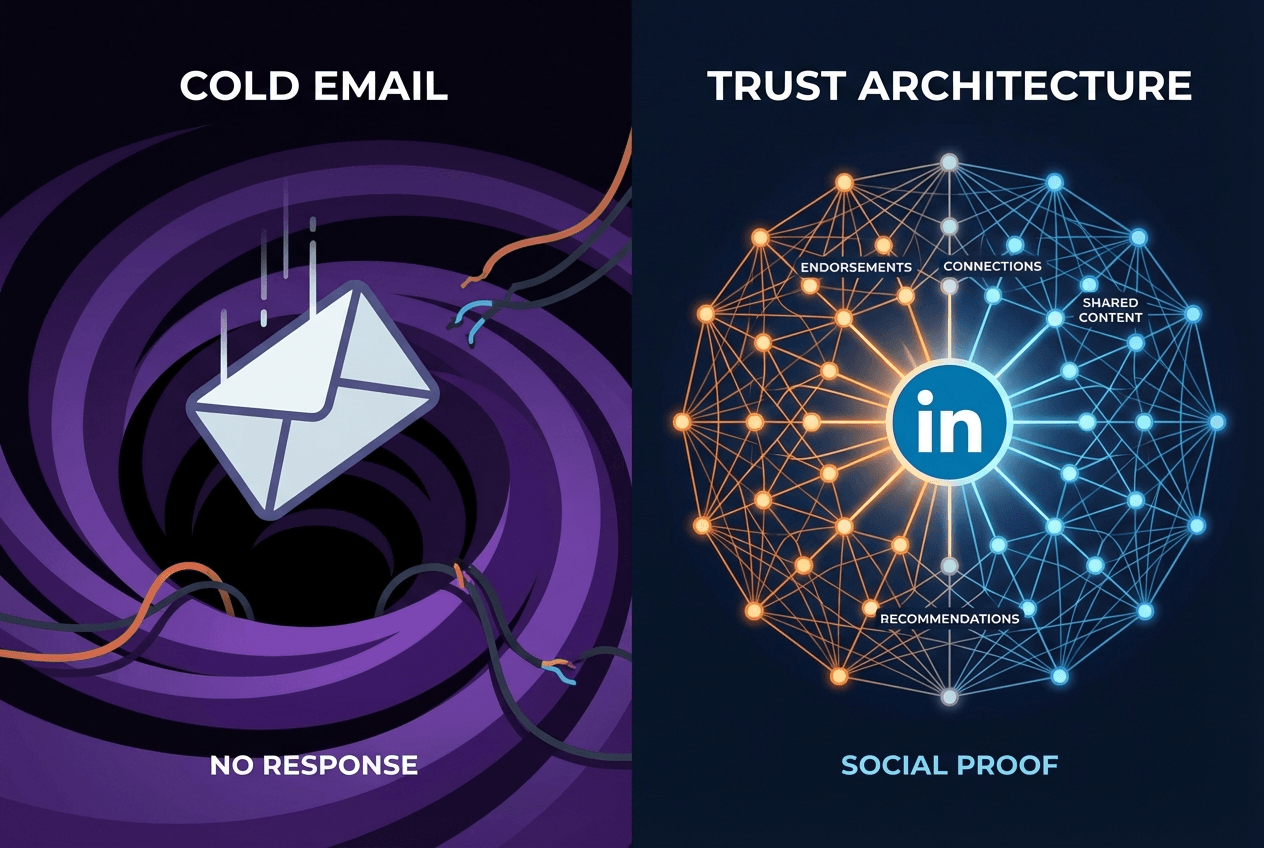
LinkedIn outreach leverages a 'trust architecture' that cold email simply cannot replicate for unvalidated brands.
Stage 3: Fast Scaling and the GEO Imperative (20-100 Customers)
Once you hit 20 customers, you finally have a statistically significant dataset. You know who your profitable customers are. This is the moment when paid social becomes an unstoppable engine because you can feed accurate seed data into lookalike algorithms.
But the real winners in this stage are those who invested early in GEO (Generative Engine Optimization).
We are entering an era where B2B buyers bypass search engines to ask AI models for vendor recommendations. GEO is the practice of structuring your content so that LLMs like ChatGPT or Perplexity definitively cite your brand. In our Ebots case study, we saw how building a content moat early creates a compounding organic channel that eventually makes your CAC (Customer Acquisition Cost) plummet while your competitors are still bleeding cash on Google Ads.
Find out how AI models like ChatGPT and Perplexity currently describe your business — and whether they're sending buyers to you or your competitors. Get your free GEO readiness report in minutes.
Run My AI GTM Audit →
Generative Engine Optimization (GEO) ensures your brand is the one AI models recommend when buyers ask for solutions.
The Meta-Lesson: Sequencing Beats Simultaneity
If there is one immutable law I’ve learned, it’s this: The order in which you activate your channels matters more than the channels themselves.
The companies that thrived followed a disciplined sequence — and those that invested early in custom, verticalized landing pages saw dramatically higher conversion rates at every stage. Our Haven AI case study is a compelling example: by pairing their scaled paid social campaigns with purpose-built landing pages tailored to each ICP segment, they achieved conversion rates 2–3x above industry benchmarks. A generic homepage simply cannot do what a targeted landing page can — it speaks directly to the prospect's pain, mirrors the ad's promise, and removes every possible friction point between click and conversion.
The companies that tried to do everything at once—founder sales, paid ads, heavy content, and community—almost universally failed. They fragmented their messaging and burned their capital. The companies that thrived followed a disciplined sequence:
| Stage | Customers | Primary GTM Channels | Focus |
|---|---|---|---|
| Pre-PMF | 0–10 | Founder LinkedIn + SEO Blogs | Discovery & Proof-of-Work |
| PMF ID | 10–20 | Targeted LinkedIn Outreach + GEO | Trust Building & Infrastructure |
| Fast Scaling | 20–100 | Scaled Paid Social (Lookalikes) | Algorithmic Expansion |
Not sure how to position your brand for your specific vertical? Browse our library of AI-powered landing page and campaign templates built for HealthTech, HRTech, FinTech, EdTech, and more — the same playbook Haven AI used to 2–3x their conversion rates.
Explore Templates →Looking back, the startups that succeeded were brutally honest about where they were in the lifecycle. They resisted the pressure to launch flashy campaigns until their 'plumbing' could handle the pressure. The optimal GTM playbook isn’t a secret—it’s a matter of discipline. It’s about having the humility to do the unsexy, foundational work while your competitors are busy chasing quick wins that don't last.
About the Author
Fangfang Tan is the CPO and Co-Founder of AgentWeb, an AI-powered marketing platform. Before moving into the startup world, she spent 10 years leading specialized Go-to-Market Data Science and Machine Learning teams at LinkedIn, Google and Meta. She has personally guided GTM strategy for 20+ scaling companies across diverse verticals, applying behavioral mechanism design to the art of growth.